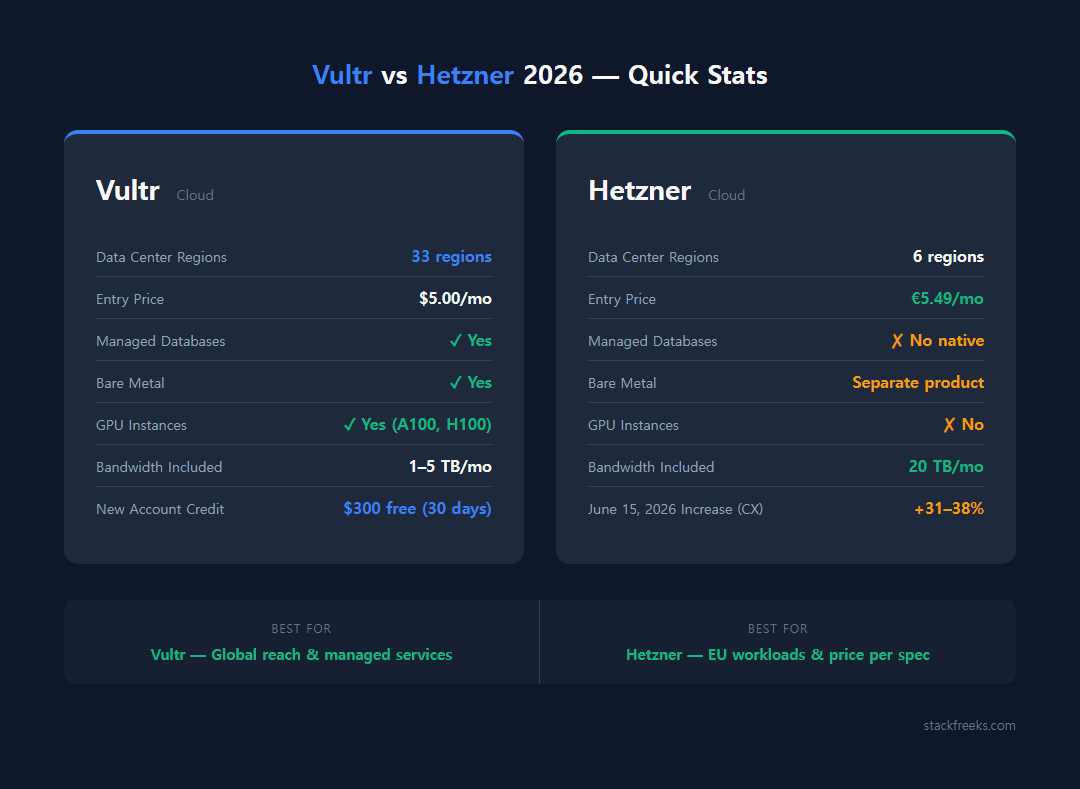
Hetzner’s CX22 can’t be ordered anymore: per Hetzner’s API changelog, CX23 replaced it for new orders on January 1, 2026. CX23 (2 vCPU, 4 GB, 40 GB NVMe, 20 TB) costs €5.49 ($6.49) a month excl. VAT and IPv4 in Germany and Finland since June 15, 2026. Hetzner’s product page listed CX23 as unavailable on 2026-10-19, so check availability before you plan around it. The Vultr vs Hetzner decision: Hetzner is far cheaper per spec in Europe, Vultr covers 33 regions to Hetzner’s 6.
This post contains affiliate links. If you purchase through our links, we may earn a commission at no extra cost to you.
Vultr vs Hetzner by use case
Before getting into specifics, here’s the high-level breakdown:
| Use Case | Winner |
|---|---|
| Lowest price per spec (any tier) | Hetzner |
| European servers + GDPR compliance | Hetzner |
| US-based audience or team | Vultr |
| Global audience (Asia-Pacific, LatAm) | Vultr |
| Managed databases (PostgreSQL, MySQL) | Vultr |
| Bare metal servers | Vultr |
| GPU / AI inference workloads | Vultr |
| Self-hosted dev environments on a budget | Hetzner |
| Included traffic (bandwidth) | Hetzner (20 TB vs 2 to 5 TB) |
| Wider 1-click app ecosystem | Vultr |
Prices last verified: October 5, 2026.
Vultr vs Hetzner 2026: pricing compared
Even after Hetzner’s two 2026 price increases, the gap is significant.
Hetzner Cloud pricing (after the June 15, 2026 adjustment)
Hetzner cited sharply higher hardware and operating costs for its April 1, 2026 increase. A second adjustment for new orders and rescales followed on June 15, 2026: roughly +31 to 38% on the CX line and +113 to 176% on CPX and CCX plans in Germany and Finland.
| Plan | vCPU | RAM | NVMe Storage | Bandwidth | Price/mo |
|---|---|---|---|---|---|
| CX23 | 2 shared | 4 GB | 40 GB | 20 TB | €5.49 |
| CX33 | 4 shared | 8 GB | 80 GB | 20 TB | €8.49 |
| CX43 | 8 shared | 16 GB | 160 GB | 20 TB | €15.99 |
| CPX22 (AMD EPYC) | 2 shared | 4 GB | 80 GB | 20 TB | €19.49 |
| CCX13 (dedicated vCPU) | 2 dedicated | 8 GB | 80 GB | 20 TB | €42.99 |
| CAX11 (ARM64) | 2 ARM | 4 GB | 40 GB | 20 TB | €5.99 |
Prices last checked: October 5, 2026 (Germany/Finland list prices, excl. VAT and IPv4). Listed in EUR; overage bandwidth at €1 ($1.20)/TB.
Every Hetzner plan in Germany and Finland includes 20 TB/month of traffic, IPv6, DDoS protection, and firewalls in the base price. A public IPv4 address costs €0.50/month extra, snapshots are billed by size, and backups are optional at +20% of the plan cost.
Vultr pricing (October 2026)
| Plan | vCPU | RAM | Storage | Bandwidth | Price/mo |
|---|---|---|---|---|---|
| Cloud Compute (IPv6 only) | 1 | 512 MB | 10 GB SSD | 0.5 TB | $2.50 |
| Cloud Compute Regular | 1 | 1 GB | 25 GB SSD | 1 TB | $5.00 |
| Cloud Compute Regular | 1 | 2 GB | 55 GB SSD | 2 TB | $10.00 |
| High Frequency | 1 | 2 GB | 64 GB NVMe | 2 TB | $12.00 |
| High Frequency | 2 | 4 GB | 128 GB NVMe | 3 TB | $24.00 |
| High Frequency | 3 | 8 GB | 256 GB NVMe | 4 TB | $48.00 |
| High Performance (AMD/Intel) | 2 | 4 GB | 100 GB NVMe | 5 TB | $24.00 |
| High Performance (AMD/Intel) | 4 | 8 GB | 180 GB NVMe | 6 TB | $48.00 |
| High Performance (AMD/Intel) | 8 | 16 GB | 350 GB NVMe | 8 TB | $96.00 |
| Bare Metal (entry) | n/a | n/a | n/a | n/a | From ~$120/mo |
Prices last checked: October 5, 2026. Listed in USD; bandwidth overage at $0.01/GB ($10/TB).
Vultr currently advertises $300 in free credit for new accounts, usable within 30 days (new customers only; check the offer when you sign up).
Side by side: same specs, very different bills
| Spec Tier | Hetzner Plan | Hetzner Price | Vultr Equivalent | Vultr Price |
|---|---|---|---|---|
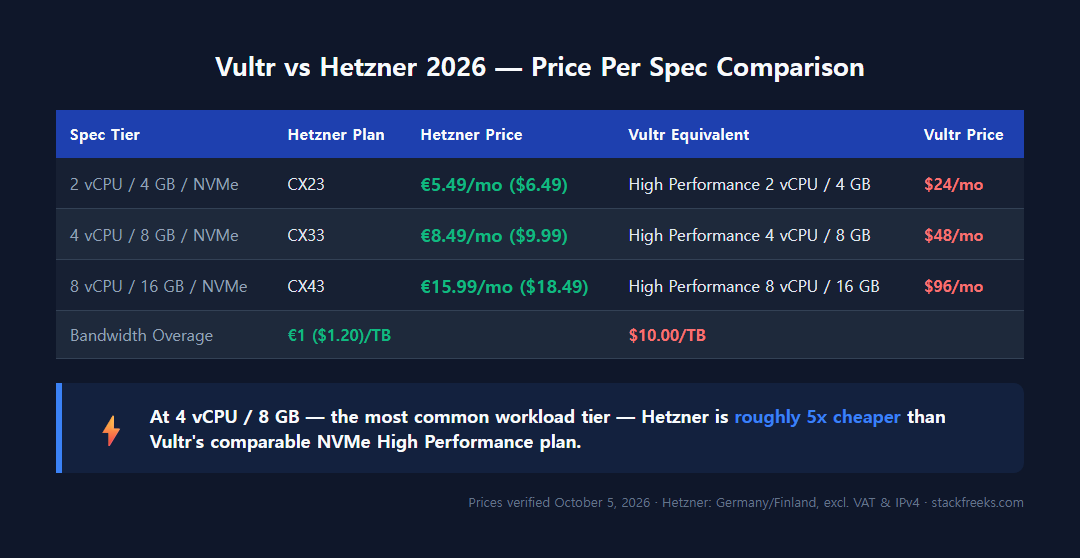
| 2 vCPU / 4 GB / NVMe | CX23 | €5.49/mo ($6.49) | High Performance 2 vCPU / 4 GB | $24/mo |
| 4 vCPU / 8 GB / NVMe | CX33 | €8.49/mo ($9.99) | High Performance 4 vCPU / 8 GB | $48/mo |
| 8 vCPU / 16 GB / NVMe | CX43 | €15.99/mo ($18.49) | High Performance 8 vCPU / 16 GB | $96/mo |
At the 4 vCPU / 8 GB tier, probably the most common “real workload” size, Hetzner is roughly 5x cheaper than Vultr’s comparable NVMe High Performance plan. A gap that size changes whether a side project is financially viable.
The bandwidth overage gap is also meaningful: Vultr charges $10/TB overage vs Hetzner’s €1 ($1.20)/TB. If you’re running anything with significant egress (media streaming, large file transfers, high-traffic APIs), Hetzner’s included 20 TB plus cheap overages can save you materially every month.
Performance: benchmarks and real-world workloads
Price-per-spec doesn’t mean much if the performance isn’t there. Here’s what independent testing shows.
CPU and general workloads
Based on 2026 benchmark data from VPSBenchmarks and BestUSAVPS:
- On a WordPress + MySQL workload, Hetzner showed query times approximately 15% lower than a comparable Vultr setup.
- For raw single-thread CPU performance, Vultr High Frequency (high-clock Intel CPUs, NVMe-backed) competes closely with Hetzner’s dedicated-vCPU CCX plans, which cost significantly more than the shared CX line.
- Hetzner’s shared CX series can show “noisy neighbor” effects during peak hours. The CCX dedicated-vCPU plans avoid this, but they’re priced higher accordingly.
Disk I/O
The disk gap is where Vultr pulls ahead at comparable price points:
- One third-party benchmark (Better Stack’s Vultr review) measured about 118,000 combined 4K random IOPS on a Vultr High Performance AMD 2 vCPU / 4 GB plan
- Hetzner CPX22 benchmarks at around 40,900 IOPS in published tests
That IOPS gap matters most for database-heavy applications such as MySQL, Redis and high-concurrency WordPress sites. For a static site or lightweight API, you won’t notice it. For a busy WooCommerce store under load, you probably will. Benchmark results vary by region and plan, so treat these as directional rather than absolute.
Given those IOPS numbers, expect Vultr’s NVMe plans to handle I/O-intensive database queries better than Hetzner’s CPX22. Against Hetzner’s cheaper CX line, the tradeoff is paying roughly 4 to 5x more for the privilege.
Network and bandwidth
- Hetzner provides a fast, consistent network within Europe. It has two US locations (Ashburn, VA and Hillsboro, OR) and one Asia location (Singapore), but its cheap CX plans are sold only in Germany and Finland. For EU-to-EU traffic, the network is excellent.
- Vultr’s 33-region network gives it a latency advantage for anything outside Europe. Nine US locations, a broad Asia-Pacific footprint (Tokyo, Seoul, Singapore, Sydney, Bangalore, Mumbai), and presence in Latin America (São Paulo) and Africa (Johannesburg) mean you can put servers close to your users almost anywhere.
Vultr’s entry tiers differ by more than 5x on CPU: our Tokyo numbers
Most Vultr vs Hetzner comparisons treat “Vultr” as one performance level. It isn’t. On 2026-09-25 we ran the same short benchmark on three of Vultr’s 1 vCPU entry plans in Tokyo, on Ubuntu 24.04, one run each: sysbench cpu --threads=1 --time=30, a 30-second fio 4k random read at queue depth 32, and a 30-second fio 1M sequential write. Hetzner wasn’t part of this test. Every Hetzner figure in this post comes from the published sources cited above; the numbers below are Vultr-only.
| Vultr plan (Tokyo) | CPU reported by lscpu | sysbench CPU, 1 thread (events/s) | fio 4k random read (IOPS) | Avg read latency (µs) | fio 1M sequential write |
|---|---|---|---|---|---|
| Regular, $5/mo | Intel Broadwell | 817.61 | 59.7k | 535.13 | 308 MiB/s |
| High Frequency, $6/mo | Intel Skylake | 1170.04 | 110k | 288.88 | 1017 MiB/s |
| High Performance AMD, $6/mo | AMD EPYC-Rome | 4303.83 | 107k | 298.59 | 1816 MiB/s |
Our test, 2026-09-25, Vultr Tokyo, Ubuntu 24.04. Neither $6 plan appears in the pricing table above, which starts High Frequency at $12.
The spread inside Vultr’s own lineup is bigger than most of the Vultr-vs-Hetzner gaps people argue about. The $6 High Performance AMD plan did 4303.83 events/s against 817.61 on the $5 Regular plan (about 5.3x) and 3.68x the 1170.04 of High Frequency at the same $6. On disk, both $6 plans landed near each other (110k vs 107k random-read IOPS) and well clear of Regular’s 59.7k. So when a benchmark says “Vultr” won or lost against a Hetzner box, the first thing to check is which Vultr tier it ran on.
Two cautions before you line these up against the Hetzner data. First, the ~118,000 combined 4K IOPS figure quoted earlier comes from a 2 vCPU High Performance AMD plan and is in the same range as our 107k on the $6 AMD plan, but it’s a combined read/write test on a larger plan, while ours is read-only, so they aren’t the same measurement. Second, our sysbench scores can’t be compared directly with Hetzner sysbench results published elsewhere: different hosts, dates and settings. Also, sysbench’s prime-number test rewards newer CPU generations heavily, which flatters EPYC-Rome against Skylake and Broadwell.
What this changes in practice: if location or managed services push you to Vultr, the like-for-like starting point against a cheap Hetzner CX plan is the $6 AMD plan, not the $5 Regular one. Check that it’s offered in your region first. The full run, raw output included, is in our Vultr Cloud Compute vs High Frequency benchmark.
Honest scope: one 30-second sample per plan, one region, one day. It’s what those three instances did on 2026-09-25, not a long-term average, and a different host or a busy neighbour could shift the numbers.
Features comparison: what each platform actually offers
| Feature | Hetzner Cloud | Vultr |
|---|---|---|
| Managed Kubernetes | No native offering (third-party options) | Yes (control plane free) |
| Managed Databases | No native offering* | Yes (PostgreSQL, MySQL, Valkey) |
| Object Storage | Yes (S3-compatible) | Yes (S3-compatible) |
| Load Balancers | Yes | Yes |
| Block Storage | Yes (Volumes) | Yes |
| GPU Instances | No | Yes (NVIDIA A100, H100) |
| Bare Metal | No (separate product line) | Yes (from ~$120/mo) |
| Private Networking | Yes (vSwitch) | Yes |
| DDoS Protection | Included | Add-on ($10/mo per instance) |
| 1-Click App Library | Limited | Broader |
| Terraform Support | Excellent | Good |
| Data Center Regions | 6 | 33 |
| 2FA Method | Yes (incl. YubiKey) | TOTP + others |
*Hetzner does not offer managed relational databases as a native cloud product. Community tools like Coolify fill some of this gap, but it’s not the same as Vultr’s first-party managed database service. If that distinction matters to your stack, Hetzner is a harder sell.
The other notable gap is bare metal. Vultr offers bare metal servers starting around $120/month directly through the same dashboard and API you use for VPS. Hetzner has dedicated servers, but they’re a separate product category under a different part of the platform. If you need to go from VPS to bare metal without changing providers or APIs, Vultr handles that cleanly.
In June 2026, Vultr also announced a partnership with HPE and NVIDIA to deploy NVIDIA GB300 NVL72 systems for large-scale AI inference. If GPU compute is on your roadmap at all, Vultr’s direction is clearly toward that market.
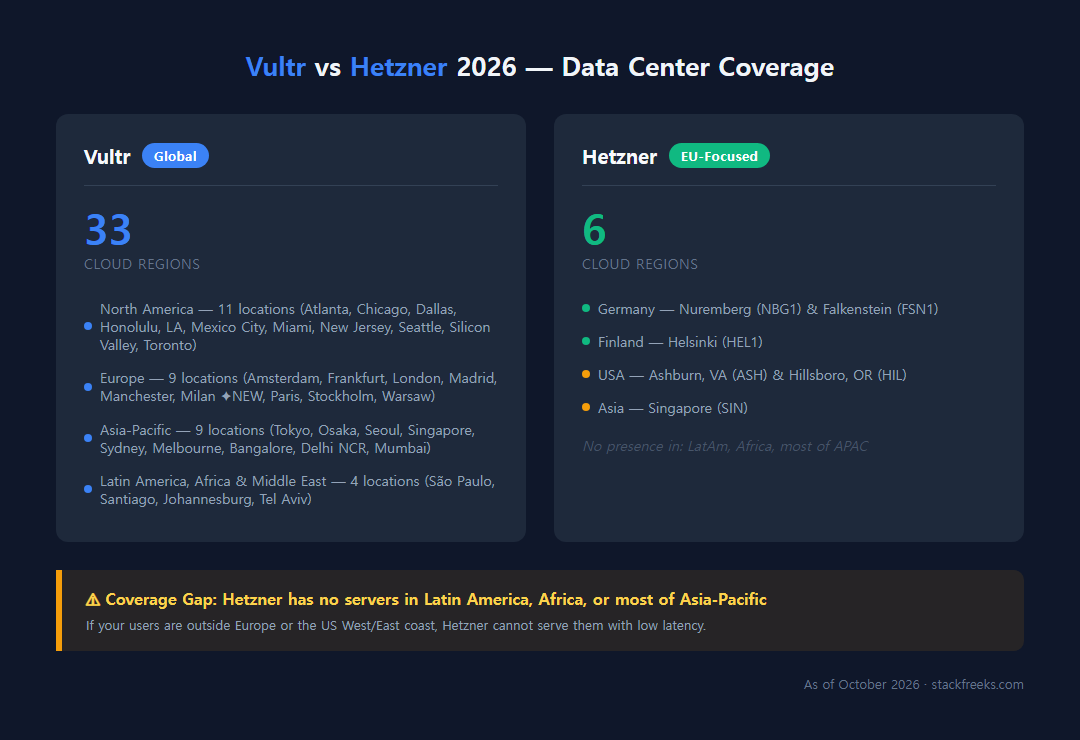
Data center coverage: Vultr vs Hetzner 2026
Location matters more than most pricing comparisons admit. A faster, cheaper server in the wrong geography can still deliver worse latency to your actual users than a slightly slower server in the right one.
Hetzner Cloud regions
- Nuremberg, Germany (NBG1)
- Falkenstein, Germany (FSN1)
- Helsinki, Finland (HEL1)
- Ashburn, Virginia, USA (ASH)
- Hillsboro, Oregon, USA (HIL)
- Singapore (SIN)
Six cloud regions total. Two in Germany, one in Finland, two in the US, one in Singapore. If your audience is European, this is probably fine. If it’s global, you’re working around a real constraint.
Vultr regions (33 total, as of October 2026)
North America (11): Atlanta, Chicago, Dallas, Honolulu, Los Angeles, Mexico City, Miami, New Jersey, Seattle, Silicon Valley, Toronto
Europe (9): Amsterdam, Frankfurt, London, Madrid, Manchester, Milan (new May 2026), Paris, Stockholm, Warsaw
Asia-Pacific: Tokyo, Osaka, Seoul, Singapore, Sydney, Melbourne, Bangalore, Delhi NCR, Mumbai
Latin America / Other: São Paulo, Santiago, Johannesburg, Tel Aviv
Vultr’s 9th European region, Milan (Italy), launched in May 2026, bringing it to full European coverage across the major markets. Vultr claims its network reaches 90% of the world’s population within 2 to 40 milliseconds.
If you’re building a product with users in Southeast Asia, Latin America, or need multi-region redundancy across more than two continents, Hetzner literally cannot serve those requirements. Vultr can.
Who should choose Vultr and who should choose Hetzner
Choose Hetzner if:
- Your users and servers are primarily in Europe. Hetzner’s EU infrastructure is fast, well-connected, and GDPR-compliant by jurisdiction.
- You’re cost-conscious and comfortable managing your own database layer. The savings at the 4 vCPU / 8 GB tier (€8.49 vs $48/month) fund a lot of other infrastructure.
- You’re running WordPress, hobby projects, dev environments, internal tools, or anything that doesn’t need global distribution.
- You want excellent Terraform/API automation without paying a premium. Hetzner’s API is well-documented and has first-class community tooling.
- You need high bandwidth included in the base price: 20 TB/month with cheap overages is hard to beat.
Hetzner is not for you if you need managed databases, servers outside Europe/limited US presence, GPU instances, or a broader managed services ecosystem. It’s also not a great fit if you’re a US-based team that needs fast support, since Hetzner’s support documentation is sparse compared to Vultr.
Choose Vultr if:
- Your audience spans multiple continents or is primarily outside Europe. Nine US regions and full Asia-Pacific coverage give you options Hetzner can’t match.
- You need managed databases (PostgreSQL, MySQL, Valkey) without running your own. This is a hard requirement for many stacks, and Hetzner doesn’t cover it natively.
- You’re building for a global product and need to provision servers close to users in Southeast Asia, Latin America, or Africa.
- You need bare metal or GPU instances through the same API/dashboard as your VPS fleet.
- You want a broader 1-click app library and more polished documentation for common setups.
Vultr’s $300 new-account credit gives you a meaningful runway to test the platform across different instance types before you commit, but it has to be used within 30 days, so plan a one-month trial.
Vultr is not the right call if price-per-spec is your only criterion and your workload fits within Europe. At equivalent specs, you’ll spend roughly 4 to 5x more than Hetzner for the same RAM and vCPU count.
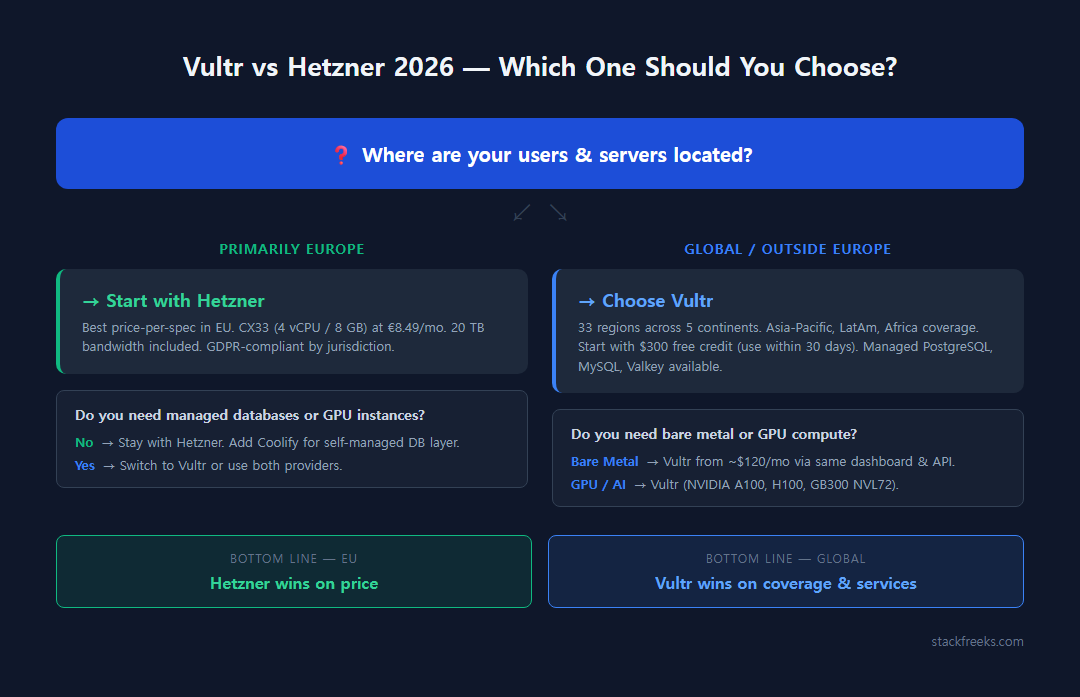
Hetzner wins on price; Vultr wins outside Europe
Hetzner wins on price. If you’re a European developer running cost-sensitive workloads (dev servers, internal tools, self-hosted applications, WordPress sites for EU audiences), nothing in the mainstream VPS market touches Hetzner’s value per euro, even after the 2026 increases.
Vultr wins on coverage (33 regions vs 6), managed services (databases, Kubernetes, GPU instances), bare metal options, and the breadth of its ecosystem. If you’re building a global product, managing a distributed team across time zones, or need managed PostgreSQL without running your own database servers, Vultr is the more complete platform.
The recommendation is straightforward: start with Hetzner if you’re in Europe and cost matters. Switch to Vultr (or use both) when your requirements push you outside what Hetzner’s limited location set can serve.