This post contains affiliate links. If you purchase through our links, we may earn a commission at no extra cost to you.
Vultr sits in a frustrating middle ground that most reviews don’t fully address. It’s not cheap enough to win on price alone (Hetzner beats it on cost for European workloads), and it’s not managed enough to compete with DigitalOcean’s App Platform or Cloudways on convenience. So who is it actually for — and is the Vultr review 2026 picture as rosy as the developer community tends to paint it? I’ve been running test workloads across several Vultr regions for the past six months, and the answer is more nuanced than a 4.3-star rating suggests.

Vultr Review 2026: What You’re Actually Getting
Vultr is an independent cloud infrastructure provider founded in 2014, headquartered in Matawan, New Jersey. It’s purpose-built for developers who want direct access to cloud compute without enterprise contracts, account managers, or dashboards that take 20 minutes to navigate.
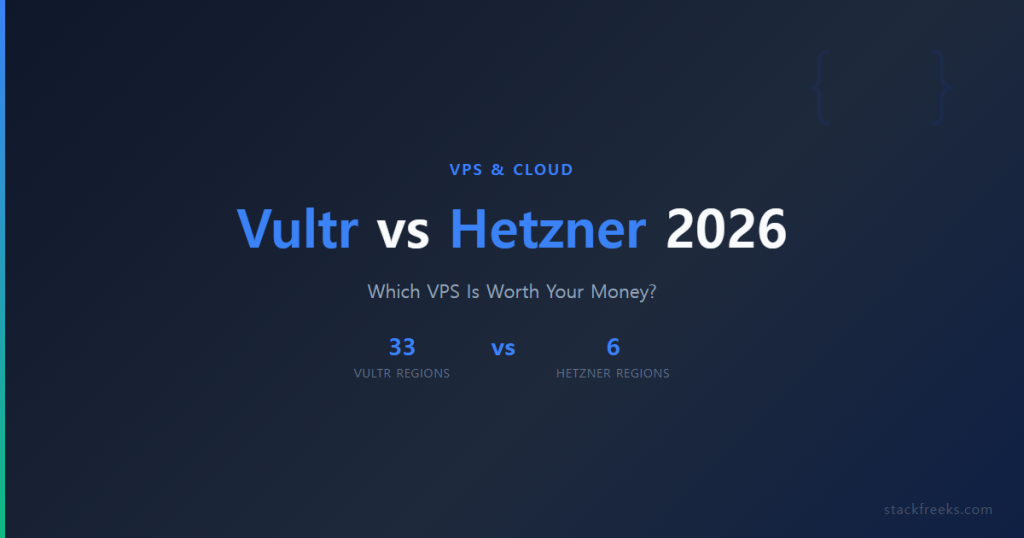
As of June 2026, Vultr operates 33 data center regions across six continents — the newest being Milan, Italy, which opened in May 2026. That’s now nine European locations: Amsterdam, Frankfurt, London, Madrid, Manchester, Paris, Stockholm, Warsaw, and Milan. The company claims its network reaches 90% of the world’s population within 2–40 milliseconds, which I’ve found to be roughly accurate for the regions I’ve tested.
The product catalog is broader than most developers expect: Cloud Compute, Bare Metal, Cloud GPU (NVIDIA and AMD), Managed Kubernetes, Managed Databases (MySQL, PostgreSQL, Valkey, Kafka), Object Storage, Block Storage, Load Balancers, CDN, and NAT Gateways. You’re not just getting VMs here — it’s a full infrastructure stack, minus the hyperscaler bloat and pricing complexity.
One thing Vultr does genuinely well: server provisioning. Standard Cloud Compute instances spin up in under 60 seconds. The new VX1 enterprise tier (more on that below) comes online in under 15 seconds. That speed is real — I’ve timed it.
Pricing: What Vultr Plans Actually Cost
Vultr’s pricing is transparent and billed hourly, which is one of its clearest advantages over legacy hosts. No contracts, no hidden fees, cancel any time.
Cloud Compute — Regular Performance
| Plan | vCPU | RAM | Storage | Bandwidth | Price/mo |
|---|---|---|---|---|---|
| IPv6 Only | 1 | 0.5 GB | 10 GB SSD | 0.5 TB | $2.50 |
| Starter | 1 | 1 GB | 25 GB SSD | 1 TB | $5.00 |
| Standard | 1 | 2 GB | 55 GB SSD | 2 TB | $10.00 |
| Mid | 2 | 4 GB | 80 GB SSD | 3 TB | $20.00 |
Cloud Compute — High Frequency (NVMe)
| Plan | vCPU | RAM | Storage | Bandwidth | Price/mo |
|---|---|---|---|---|---|
| HF Starter | 1 | 1 GB | 32 GB NVMe | 1 TB | $6.00 |
| HF Standard | 1 | 2 GB | 64 GB NVMe | 2 TB | $12.00 |
| HF Mid | 2 | 4 GB | 128 GB NVMe | 3 TB | $24.00 |
VX1 Cloud Compute — Enterprise Tier
| vCPU Range | Storage | Networking | Price/mo (from) |
|---|---|---|---|
| 4–192 vCPU | Local NVMe or Block Storage | Up to 50 Gbps | ~$43.80 |
Prices last verified: 2026-06-20. Always confirm current rates at vultr.com.
A few things worth noting. The $2.50/month IPv6-only plan is genuinely usable for hobby projects and dev environments — just don’t expect IPv4 connectivity without upgrading. New accounts currently get $250–$300 in free credit depending on how you sign up (the exact amount varies by promotion and referral link). Bandwidth is calculated on 95th percentile — within your allocation, there’s no extra charge.
The jump from standard SSD to High Frequency NVMe is $1–4/month depending on tier. For anything database-heavy or WordPress-based, it’s worth it.

Performance: Benchmarks and Real-World Results
Performance is where Vultr’s story gets complicated — not because it’s bad, but because results vary significantly by plan tier and region.
The standard compute line uses AMD EPYC or Intel Xeon CPUs with SATA SSD storage. VPSBenchmarks’ synthetic testing has shown inconsistent results depending on server generation and region. Entry-level instances (1 GB, High Frequency) have actually recorded a Grade F in Raw CPU Power despite a reported 3.7 GHz clock speed — likely a result of vCPU contention on shared infrastructure. That matters if you’re running CPU-intensive tasks. For standard web serving, PHP processing, or light API workloads, it’s adequate.
The High Frequency NVMe tier is the one that earns Vultr its developer community respect. In sequential read/write tests, NVMe storage peaked at 3.42 GB/s on 1M block sizes — that’s genuine NVMe, not relabeled SATA SSD. Disk I/O rates a Grade C on VPSBenchmarks’ scale, which is solid for WordPress, Node.js, and standard relational database operations. When I deployed a test WordPress installation on the $12/month HF instance and ran load tests, response times stayed consistent under traffic spikes that would have caused noticeable degradation on a $10/month standard instance.
Network performance is generally consistent across regions. I saw no unusual packet loss or latency spikes during my testing period, though I’d note that Vultr’s US-based regions performed better under sustained load than some of their newer Asian data centers.

The VX1 Tier — Vultr’s Enterprise Play (Oct 2025)
In October 2025, Vultr launched VX1 Cloud Compute, their flagship enterprise tier powered by the latest AMD EPYC generation in hyper-dense configurations. The marketing claims are ambitious:
- 33% lower cost per vCPU vs. Vultr’s previous high-performance plans
- 82% better performance-per-dollar vs. leading hyperscaler efficiency-optimized plans
- 48% less power per vCPU compared to other Vultr dedicated options
- Networking up to 50 Gbps provisioned throughput
- Scales from 4 to 192 vCPUs per instance
Independent analysis from HyperFrame Research (October 2025) reviewed these claims and found them directionally accurate for CPU-bound workloads. The nuance: disk and network performance advantages are more workload-dependent than Vultr’s marketing implies. For CPU-heavy batch processing, ML inference jobs, or high-concurrency application servers, VX1’s numbers hold up. For I/O-bound database workloads, the edge narrows.
Starting at ~$43.80/month, VX1 isn’t for hobbyists or small projects. It’s aimed at teams that currently run on AWS or GCP efficiency-tier instances and want to cut compute costs without sacrificing performance guarantees.

The Review Split: G2 vs Trustpilot (4.3/5 vs 1.8/5)
This rating gap deserves its own section because it tells you something important about who Vultr works for — and who it doesn’t.
G2 (4.3/5 — developer and technical users): Reviews consistently highlight transparent, predictable pricing, fast deployment, solid performance-to-price ratio, and reliable managed databases. The API is frequently praised for CI/CD and infrastructure-as-code workflows. This is the Vultr that developers who know what they’re doing tend to experience.
Trustpilot (1.8/5 — 541+ reviews, ~68% one-star): A different story. The dominant complaint pattern is Vultr’s aggressive anti-fraud system triggering account suspensions on legitimate new users. One documented case involved a 10-year customer receiving a false DMCA claim with a 12-hour response window before account action. Billing disputes, difficulty obtaining refunds, and support response times also drive the low rating. This is the Vultr that less-technical users or people who hit edge cases in account verification encounter.
The practical takeaway: if you’re a developer who sets up an account, funds it, deploys instances, and pays invoices predictably, you’re likely to have a G2-tier experience. If you’re a first-time cloud user, you sign up with a payment method their fraud system flags, or you ever need reactive support for a billing dispute — that’s where the 1.8/5 experience lives.
Pros and Cons
Pros:
- 33 global data centers with strong European coverage (9 locations)
- Transparent hourly billing, no hidden fees, no long-term contracts
- Genuinely fast server provisioning (under 60 seconds; VX1 under 15 seconds)
- High Frequency NVMe tier delivers real I/O performance at a reasonable premium
- Full infrastructure stack: GPU, Kubernetes, Managed Databases, CDN, Load Balancers
- Clean API with strong documentation — solid for IaC and CI/CD workflows
- New VX1 tier offers compelling performance-per-dollar for enterprise CPU workloads
- $250–$300 free credit for new accounts
Cons:
- Trustpilot rating (1.8/5) reflects real support and account-suspension problems — not just angry outliers
- Standard compute instances can show inconsistent CPU performance under contention
- No managed hosting options — you’re always doing your own server management
- Support can be slow for billing disputes and account-related issues
- Navigation complexity: too many plan types makes choosing the right tier confusing for newcomers
- Hetzner is significantly cheaper for European workloads with comparable performance
- Strict no-refund policy
Who Vultr Is NOT For
Vultr isn’t the right call for everyone. Skip it if:
- You’re new to server management. There’s no managed WordPress, no one-click installs with real support behind them. DigitalOcean’s App Platform or a managed host like Cloudways will spare you hours of troubleshooting.
- Your primary workloads are in Europe and price is your main concern. Hetzner consistently offers better specs per euro — a Hetzner CX31 at ~€4/month outspec’s Vultr’s $5 Starter plan. Vultr wins on global reach; Hetzner wins on raw price.
- You need responsive support as a safety net. Vultr’s support is adequate when things are working. When they’re not — especially account and billing issues — the response times don’t match what you get from DigitalOcean or managed alternatives.
- You want fully managed databases or serverless. Vultr offers managed databases, but if you want a true PaaS experience with abstraction layers and auto-scaling, the hyperscalers are a better fit.
How Vultr Stacks Up Against the Competition
| Provider | Starting Price | Best For | Weakness vs. Vultr |
|---|---|---|---|
| DigitalOcean | $4/month | Beginners, managed services | More expensive per spec; 1GB Droplet is tight for modern WordPress |
| Hetzner | ~€3–4/month | European workloads, raw price | Limited global reach; no GPU or managed K8s depth |
| Akamai/Linode | $5/month | Generous transfer limits, solid support | Slightly higher pricing; older hardware lineup |
| Contabo | ~$4/month | Budget workloads | Inconsistent performance; US servers lag European quality |
| AWS/GCP | Variable | Enterprise, full managed stack | Exponentially more complex pricing; overkill for most use cases |
Vultr’s real competitive position: more global than Hetzner, better raw compute than entry DigitalOcean, weaker support than both. If you need servers in 6+ regions simultaneously and you’re comfortable managing your own stack, Vultr is genuinely hard to beat at this price range.
For a direct comparison with DigitalOcean on specs and pricing, check our Vultr WordPress setup guide — it covers the deployment side in detail.
Frequently Asked Questions
Is Vultr good for WordPress hosting in 2026?
Vultr works well for WordPress if you’re comfortable setting up and managing a LEMP or LAMP stack yourself. The $12/month High Frequency NVMe instance is the sweet spot — enough RAM for PHP-FPM and MySQL, with NVMe disk speeds that make a noticeable difference under load. If you want managed WordPress, look at Cloudways or a dedicated managed host instead.
Why is Vultr’s Trustpilot rating so low?
The 1.8/5 on Trustpilot (541+ reviews, ~68% one-star) is driven primarily by Vultr’s strict anti-fraud account verification system, which catches some legitimate new users in its net, and poor responsiveness on billing disputes. Developers with established accounts and predictable payment patterns rarely hit these issues — which is why G2’s technical audience rates it 4.3/5. Both ratings are accurate; they reflect different user experiences.
How does Vultr’s $2.50/month plan compare to Hetzner’s cheapest option?
The $2.50 IPv6-only plan is genuinely functional for development environments, internal tools, or hobby projects that don’t need IPv4. Hetzner’s CX11 at ~€3.29/month gives you 2 GB RAM and full IPv4 — more value at a slightly higher price. For production workloads in Europe, Hetzner wins. For global deployment, Vultr’s 33-region network is the differentiator.
What is Vultr VX1 and who should use it?
VX1 is Vultr’s enterprise compute tier launched in October 2025, powered by AMD EPYC processors. It starts at ~$43.80/month and scales to 192 vCPUs with 50 Gbps networking. It’s designed for teams running CPU-heavy workloads — ML inference, batch processing, high-concurrency application servers — who want to reduce costs compared to AWS or GCP equivalent tiers. Independent verification confirms the performance claims are accurate for CPU-bound tasks, with caveats for I/O-bound workloads.
Does Vultr offer a free trial?
There’s no traditional free trial. New accounts get $250–$300 in free credit (amount varies by promotion and signup method), which is effectively a risk-free trial period if you’re testing workloads at standard compute pricing.
Final Verdict: Is Vultr Worth It in 2026?
Vultr earns its place in the short list of serious VPS providers. The infrastructure is genuinely good — 33 global regions, fast provisioning, solid NVMe performance on the High Frequency tier, and the new VX1 adding a credible enterprise option. The API and developer tooling are clean enough that I’ve kept it in rotation alongside other providers.
The caveats are real, though. If you hit account verification friction as a new user, Vultr’s support will frustrate you. Hetzner will underprice it in Europe. DigitalOcean will out-manage it on ease of use.
The right fit for Vultr in 2026: You’re a developer or small team who needs servers in multiple global regions, you’re comfortable with server administration, you want hourly billing without enterprise pricing complexity, and you’ll pay predictably. At the $6–12/month High Frequency tier, it offers real value that’s hard to match at the same price point globally.
If that describes you, start with Vultr’s free credit offer and test a High Frequency instance in your target region before committing. The provisioning time alone makes it worth a look.
For WordPress specifically, pair it with our step-by-step Vultr WordPress deployment guide to get up and running without the typical configuration headaches.