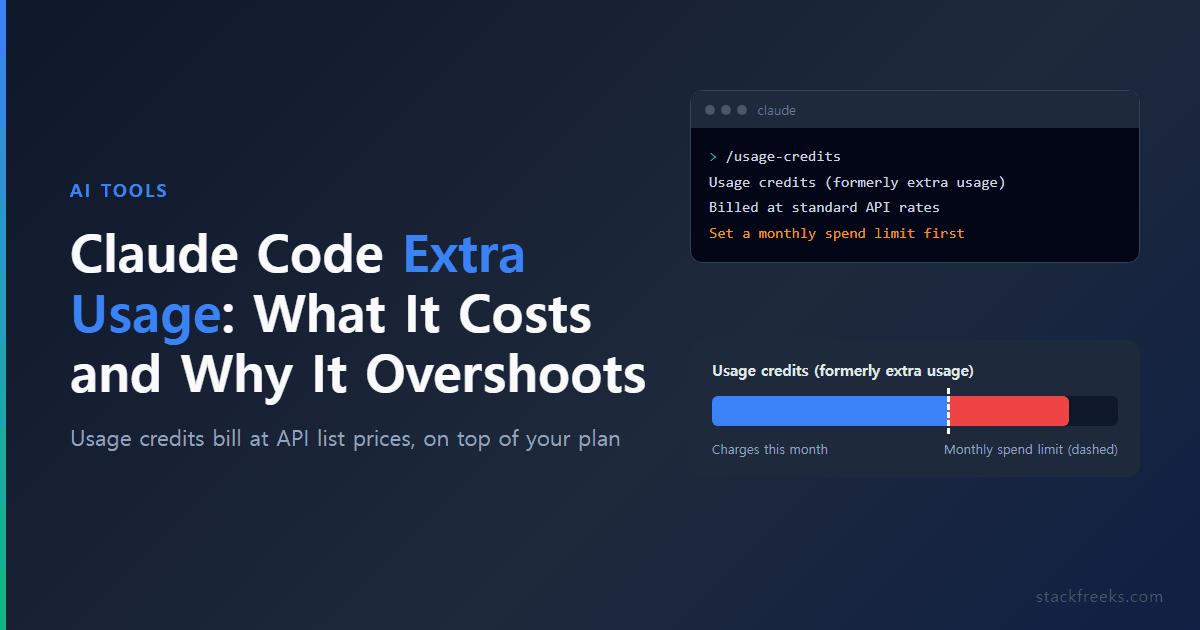
Claude Code Extra Usage doesn’t exist under that name anymore. Anthropic renamed it usage credits — it’s “Usage credits” in Settings > Usage and /usage-credits in the CLI — though the Help Center URL still says extra-usage-for-paid-claude-plans, and most people still search for the old term. The mechanics are the same: once you turn it on, anything beyond your plan’s limits is billed at standard API rates, as a separate charge on top of your $20 Pro, $100 Max 5x or $200 Max 20x subscription.
That’s list price, not a subscriber discount. Opus 5.5 costs $4 per million input tokens and $20 per million output tokens, and Fable 5.1 costs $10 in and $50 out. And there are several situations where Claude Code spends those credits even though your plan still has quota left. Below: what credits actually cost per turn, when they get spent without warning, what users have reported about the monthly cap being exceeded, and the settings that keep the bill predictable.
How Claude Code Extra Usage Billing Works Now
If you want to know how the 5-hour session and weekly limits themselves work, that’s covered in our Claude Code rate limits guide. This post is only about what happens once you’re past them and paying for it.
According to the Claude Help Center article on usage credits, credits are prepaid: you enable them at Settings > Usage on claude.ai, add a payment method and click “Add funds.” Optional auto-reload buys more whenever your balance drops below a threshold you set. You set a monthly spend limit, and there’s a daily redemption ceiling of $2,000. Credits generally don’t expire (Japan is the exception, at six months), and mobile-app subscribers can only enable them on the web.
Inside Claude Code, /usage-credits opens that settings page for Pro and Max users (it needs a claude.ai login, not an API key). /usage shows a usage-credits row with your current-month spend against your monthly limit — or “Unlimited” with no spend figure at all if you never set one.
One trap: the dollar figure in the Session block of /usage isn’t your bill. The Claude Code costs docs say it’s intended for API users, computed locally at list price, and “isn’t relevant for billing purposes” on Pro and Max. The authoritative number for subscribers is Settings > Usage on claude.ai.
What Usage Credits Cost per Million Tokens
Credits bill at the same rates as the API. From Anthropic’s API pricing page, per million tokens (MTok):
| Model | Input | 5-min cache write | 1-h cache write | Cache hit | Output |
|---|---|---|---|---|---|
| Fable 5.1 | $10 | $12.50 | $20 | $0.25 | $50 |
| Opus 5.5 | $4 | $5 | $8 | $0.20 | $20 |
| Opus 5 / 4.8 / 4.7 / 4.6 | $5 | $6.25 | $10 | $0.50 | $25 |
| Sonnet 5.5 / Sonnet 5 | $2 | $2.50 | $4 | $0.20 | $10 |
| Sonnet 4.6 | $3 | $3.75 | $6 | $0.30 | $15 |
| Haiku 4.5 | $1 | $1.25 | $2 | $0.10 | $5 |
| Fast mode, Opus 5.5 | $8 | — | — | — | $40 |
| Fast mode, Opus 5 / 4.8 | $10 | — | — | — | $50 |
Prices last verified: 2026-10-07.
Two details change the math. 4.6-and-later models bill the full 1M window at the normal rate — “a 900k-token request is billed at the same per-token rate as a 9k-token request” — so no surcharge, but no size discount either. And Claude 4.7+ models use a tokenizer that produces roughly 30% more tokens for the same text.
For scale, the costs docs put Anthropic’s own benchmark at “around $13 per developer per active day,” with 90% of users under $30. That’s an enterprise average on API billing, not Pro/Max credit spend, but it shows full-day work at list price lands in double-digit dollars.
Where Usage Credits Go Faster Than You Expect
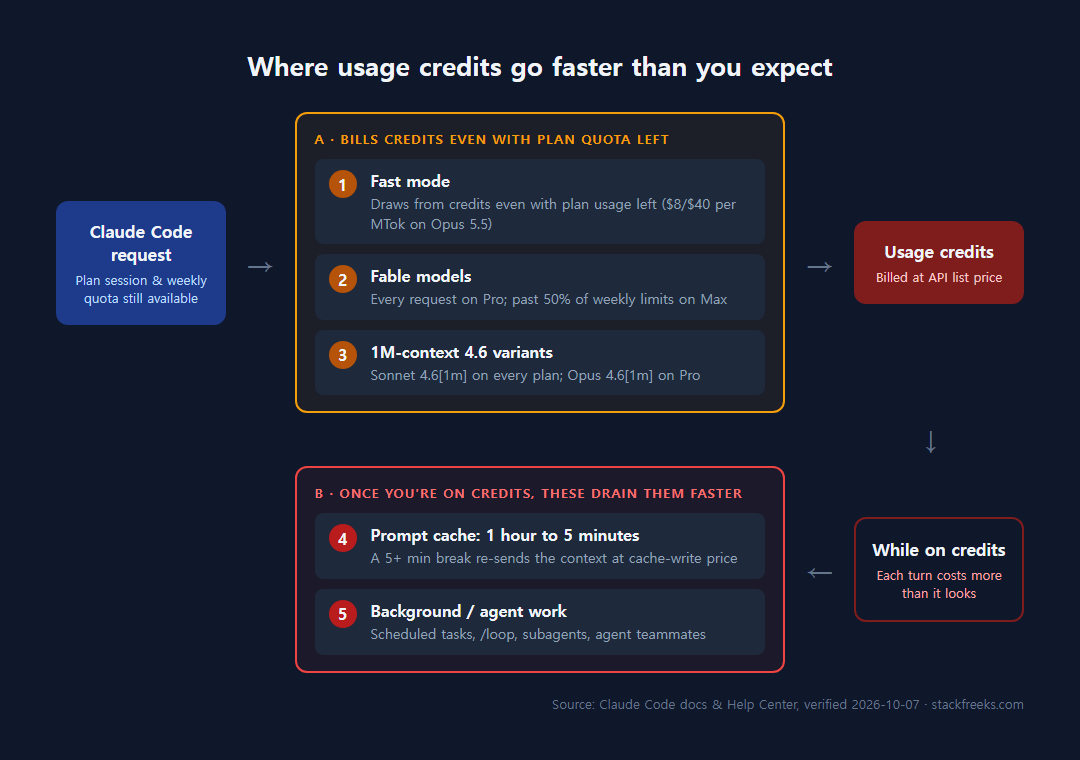
This is the part that catches people. “Extra” suggests you only pay after your plan runs out. The first three documented cases below bill credits while your plan still has quota; the last two apply once you’re on credits and drain them faster.
1. Fast mode always bills credits
The fast mode docs are blunt: for subscription users, fast mode “is available via usage credits only and not included in the subscription rate limits,” and it “draws directly from usage credits, even if you have remaining usage on your plan.” Fast mode costs double the normal Opus 5.5 rate ($8/$40 vs $4/$20).
It’s also sticky. Once you turn it on, it persists across sessions by default. Set fastModePerSessionOptIn: true to make each session start with it off, or CLAUDE_CODE_DISABLE_FAST_MODE=1 to remove it entirely. If credits run out mid-session, Claude Code falls back to standard speed and shows “Fast mode disabled · usage credits exhausted.” Settings > Usage doesn’t break fast-mode spend out separately. (Some third-party guides still say fast mode runs Opus 4.6; per the docs it supports Opus 5.5, 5 and 4.8, and 4.6 runs at standard speed and rates.)
2. Fable models: from the first token on Pro, past 50% on Max
Per the Help Center’s Fable models on your plan article (updated 2026-09-02), Fable 5 and 5.1 “aren’t included in your plan’s usage limits” on Pro and standard Team seats — every Fable request bills credits. On Max and Premium seats, you can use up to 50% of your weekly usage limits on Fable at no extra cost; after that, it’s credits.
Claude Code shows a consent prompt before a Fable request bills credits, as described in the model configuration docs. In background, Remote Control, agent-team or SDK sessions, an unanswered prompt means nothing was sent, per the errors reference. At $10/$50 per MTok, Fable is the most expensive way to spend credits.
3. 1M-context variants of the 4.6 models
The 1M variants of the 4.6 models are an entitlement, not a quota. Per the model configuration docs and the Help Center’s context window article:
- Opus 4.6[1m] is included on Max, Team and Enterprise, but needs credits on Pro.
- Sonnet 4.6[1m] needs credits on every subscription plan.
- Fable 5/5.1, Sonnet 5+ and Opus 4.7+ run 1M natively on every plan — no credits needed for the window itself.
The current error reads “API Error: Usage credits required for 1M context · run /usage-credits to turn them on…”, and the errors docs call it “an entitlement check, not a quota exhaustion” that fires even when your session and weekly allowances have room. Older reports from March–April 2026 show the earlier wording, “Extra usage is required for long context requests,” including some users who report being on Max, even though the docs say Opus 4.6[1m] is included on Max. CLAUDE_CODE_DISABLE_1M_CONTEXT=1 removes the 1M variants from the model list.
4. Once you’re on credits: the prompt cache shrinks from 1 hour to 5 minutes
The costs docs say the cache lifetime “is an hour on a subscription and drops to five minutes once you’re drawing on usage credits.” Any break over five minutes means the next message re-sends the whole conversation at the cache-write price instead of the cache-hit price. The same docs section notes you can choose the TTL yourself.
5. Once you’re on credits: background and agent work drains them faster
The same costs page lists other spenders that don’t look like “you typing a prompt”: scheduled tasks and /loop, cross-session messages, goal check-ins, subagents and workflows, and agent teammates. Agent teams “use approximately 7x more tokens than standard sessions when teammates run in plan mode.” And /compact on a large context “is itself a large request,” while /clear costs nothing.
What a Single Turn Costs: Arithmetic From List Prices
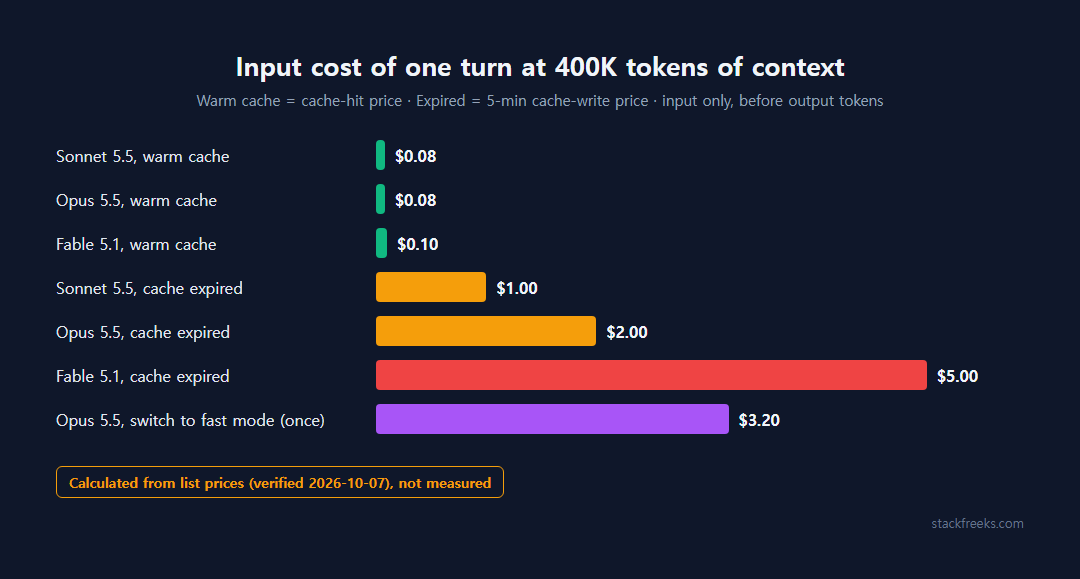
No one at StackFreeks ran a paid Claude session for this post. The numbers below are calculated from the published price table above, not measured — real bills also include output tokens and whatever else the session did.
Take a long session sitting at 400K tokens of context:
| Scenario (400K-token context) | Calculation | Cost |
|---|---|---|
| Cache expired, Opus 5.5 (5-min cache write) | 0.4 × $5.00 | $2.00 |
| Cache expired, Fable 5.1 | 0.4 × $12.50 | $5.00 |
| Cache expired, Sonnet 5.5 | 0.4 × $2.50 | $1.00 |
| Warm cache, Opus 5.5 | 0.4 × $0.20 | $0.08 |
| Warm cache, Fable 5.1 | 0.4 × $0.25 | $0.10 |
| Switch to fast mode mid-conversation, Opus 5.5 | 0.4 × $8.00 | $3.20 once |
Worked from list prices verified 2026-10-07. Input side only, before output tokens.
The fast-mode line comes straight from the docs: when you turn it on mid-conversation, “you pay the full fast mode uncached input token price for the entire conversation context.”
Put the cache rule and these numbers together. On credits, a 400K Opus 5.5 session that sits idle for six minutes costs $2.00 just to say “continue” — 25 times the $0.08 it would cost with a warm cache. On Fable, three turns that each follow an idle break cost $15 in input alone. If your monthly cap is $5 or $10, a handful of turns in a big session is enough to reach it.
Charged Over the Limit: The Spending Cap Isn’t Always a Hard Stop
Anthropic’s docs describe the monthly spend limit and say Claude Code will prompt you to raise or remove it when you reach it. They don’t say whether the limit is a hard cap or a soft one. Several GitHub reports suggest it isn’t hard:
| Issue | Opened | Configured cap | Charged | Over cap |
|---|---|---|---|---|
| #25647 | 2026-02-13 | $50/month | $74.99 (balance −$15.92) | ~150% |
| #27154 | 2026-02-20 | R$10/month | R$27.36 | ~274% |
| #39957 | 2026-03-27 | €15 budget | €16.17 | ~108% |
| #59858 | 2026-05-17 | $5/month (Max 5x) | $12.52 | ~250% |
In #25647 the user says the toggle, previously off, was re-enabled after an update, with auto-reload off. In #27154 (Opus, 1M context) the charges landed all at once after the session. In #39957 the session was 42% used and the week 32%, yet the log shows a 429 “Extra usage is required for long context requests.” In #59858 there was no in-app warning, email or hard stop. A fifth, #26690 (2026-02-18, Pro), describes about $5 charged while plan tokens remained.
All of these were closed — as “not planned,” “invalid,” “stale” or duplicates — without an Anthropic staff reply explaining what happened. So these are user reports, not confirmed bugs, and the claim that the toggle re-enabled itself rests on one user’s account.
Why might the cap get overshot? This is our interpretation, not confirmed by Anthropic. A plausible explanation is that billing is per request: a request already in flight when you cross the limit gets billed in full, and with a 400K–1M token context, one request can be worth several dollars. That would fit #27154’s “all at once after the session” pattern. Anthropic hasn’t said whether this is the mechanism, so treat your cap as a target, not a guarantee.
How to Keep Claude Code Extra Usage From Surprising You
All of these are documented settings and commands. Do them before you need credits.
- Set a low monthly limit. Pick a number you’d be fine paying two or three times over, given the reports above. Without a limit,
/usagejust says “Unlimited.” - Leave auto-reload off. With a prepaid balance and no auto-reload, your balance should bound what you can spend. That’s our inference from how prepaid credits work, not an Anthropic guarantee — and #25647 reported a negative balance with auto-reload off.
- Check spend where it’s real. Use the credits row in
/usage, and confirm in Settings > Usage on claude.ai. Ignore the Session cost estimate for billing. - Disable fast mode unless you mean it. Add
CLAUDE_CODE_DISABLE_FAST_MODE=1to your environment, or setfastModePerSessionOptIn: trueso it never carries over to a new session. - Remove 1M variants you don’t need.
CLAUDE_CODE_DISABLE_1M_CONTEXT=1takes Opus 4.6[1m] and Sonnet 4.6[1m] off the table. - Say no to the Fable prompt and run
/modelto switch to a model your plan covers, especially on Pro, where every Fable token is credits. - Use
/clearinstead of/compactwhen you don’t need the old context. Compacting a huge context is itself a big billed request. - Don’t leave a big session idle on credits. After five minutes, the next turn re-pays for the whole context.
If you get charged more than expected, the support route in the costs docs is claude.ai → your initials → Get help. Include your configured limit, the amount charged and the time window.
Who should leave usage credits off entirely? Pro users who mostly stay within limits on Sonnet, anyone who can’t afford a charge two or three times their cap, and anyone who runs unattended work — /loop, scheduled tasks, agent teams — since nobody is watching the meter. Who should turn it on? Max users who occasionally hit the weekly cap right before a deadline, and Pro users who specifically need Fable and are willing to pay $10/$50 per MTok for it.
If you’re in the second group, turn on Claude Code Extra Usage with a small limit, auto-reload off and fast mode disabled, then check Settings > Usage after your first heavy session. If you’re comparing AI coding budgets, the same overage pattern shows up in why Cursor bills climb and how GitHub Copilot’s AI credits are billed.