This post contains affiliate links. If you purchase through our links, we may earn a commission at no extra cost to you.
If you turned on Cursor’s Auto mode sometime last year and never touched the model picker again, the math you did back then is out of date. Whether Cursor Auto Mode is worth it in 2026 depends on a billing change that landed on July 22, 2026, plus a quality reputation that’s been genuinely mixed depending on exactly when you ask. Auto used to sidestep your credit pool entirely — now it draws from it, just routed to (hopefully) cheaper models than you’d pick by hand. That’s a different value proposition than the one Auto shipped with, and most pricing explainers online haven’t caught up.
What Cursor Auto Mode Actually Does Now
Auto isn’t a single model. It’s a routing decision. Instead of you manually picking Claude, GPT, Gemini, or one of Cursor’s own Composer/Grok models for every request, Auto analyzes the query and sends it wherever Cursor’s system judges appropriate — a cheap model for a trivial edit, a stronger reasoning model for architecture work.
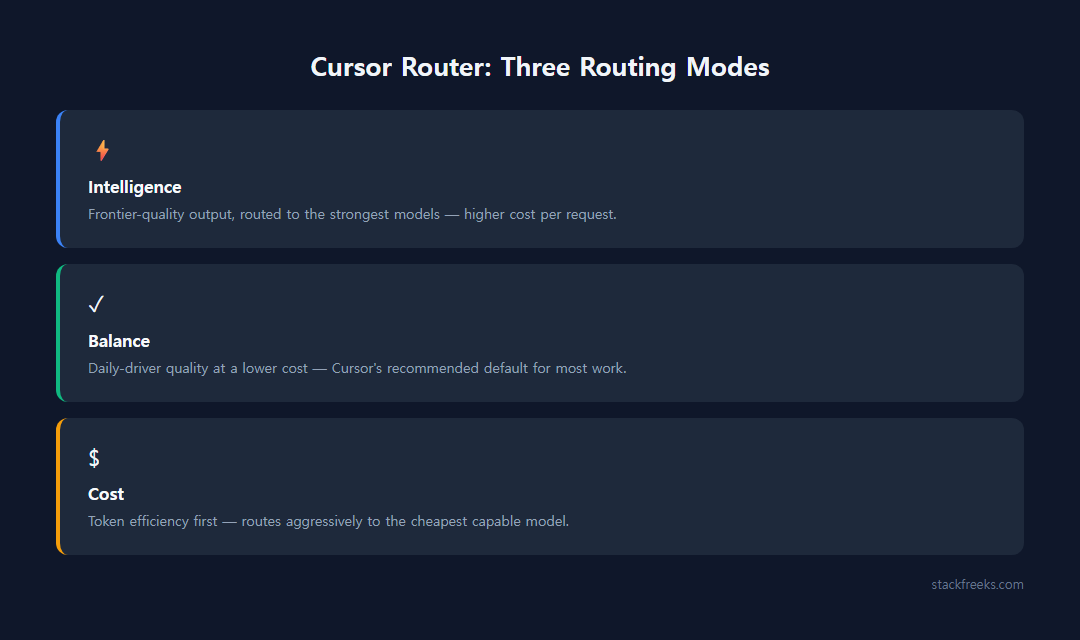
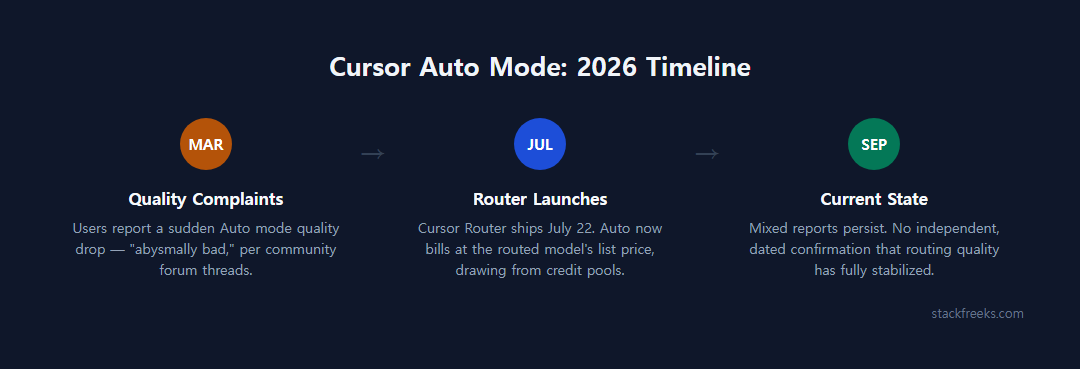
As of July 22, 2026, that routing runs on Cursor Router, a classifier trained on more than 600,000 live coding requests. According to Cursor’s own launch post, Router looks at “the query, surrounding context, and task complexity” and biases toward cost-efficient models for routine work, design-capable models for UI tasks, and frontier models for genuinely hard problems. Teams and Enterprise users can tilt the router toward one of three modes: Intelligence (frontier output, higher cost), Balance (daily-driver quality at lower cost), or Cost (token efficiency first).
Before Router existed, Auto’s selection logic was effectively opaque. Independent testers at Vibe Coding Academy described it as “a black box: consumers do not know which underlying models are being selected or how they are chosen,” and threads on Cursor’s own community forum asking “which models are behind Auto mode?” never got a definitive public answer. Even post-Router, Cursor hasn’t published the full model roster behind each mode — Composer 2.5 (post-trained from Moonshot’s Kimi K2.5, scoring 79.8% on SWE-Bench Multilingual, shipped May 18, 2026), Grok 4.5, and Grok 4.6 are the confirmed names in the “Cursor Models” pool, but the exact routing rules stay undisclosed.
Cursor Auto Mode Pricing: The Timeline That Actually Matters
This is the single most confusing fact in this whole topic, and it’s worth treating as a timeline rather than a contradiction to resolve — because both descriptions below were accurate, just at different points in 2026.
Earlier in 2026, Auto mode on paid plans was widely described as effectively unlimited: flat rates of $1.25 per million tokens for input and cache writes, $6.00 per million for output, and $0.25 per million for cache reads — and critically, none of that usage touched your monthly credit pool. Only manually selecting a premium model like Opus or a GPT-5-class model pulled from your included credits. That’s the version of Auto that earned its “free unlimited AI” reputation, and it’s still the version described on several pricing-explainer sites like Vantage and Finout.
Since the July 22, 2026 Router rollout, Cursor’s own current documentation states plainly: “all Auto modes bill at the list price of the model each request is routed to.” Third-party models — Claude, GPT, Gemini — also carry a flat $0.25-per-million-token “Cursor Token Rate” surcharge on top of the underlying API cost. Auto usage now draws from one of two separate monthly pools: the Cursor Models pool (Grok, Composer) or the Other Models pool (Claude, GPT, Gemini), depending on what gets routed. Once a pool is exhausted, overage billing kicks in at the same rates, or you upgrade your plan. There’s one narrow holdout: legacy Enterprise Auto usage keeps flat per-token pricing regardless of routed model, but only until September 7, 2026.
If you learned Cursor’s pricing model before July 2026 and haven’t revisited it, the core assumption you’re carrying — “Auto doesn’t touch my credits” — is no longer accurate per Cursor’s own documentation.
The practical shift: savings no longer come from Auto being off-metered. They come from Auto (in theory) routing more of your requests to cheaper models than you’d pick manually, so the same credit pool lasts longer. If you’ve ever opened your usage dashboard and wondered why the numbers looked different than expected, our breakdown of why Cursor bills run high covers the mechanics of that credit-pool math in more detail.
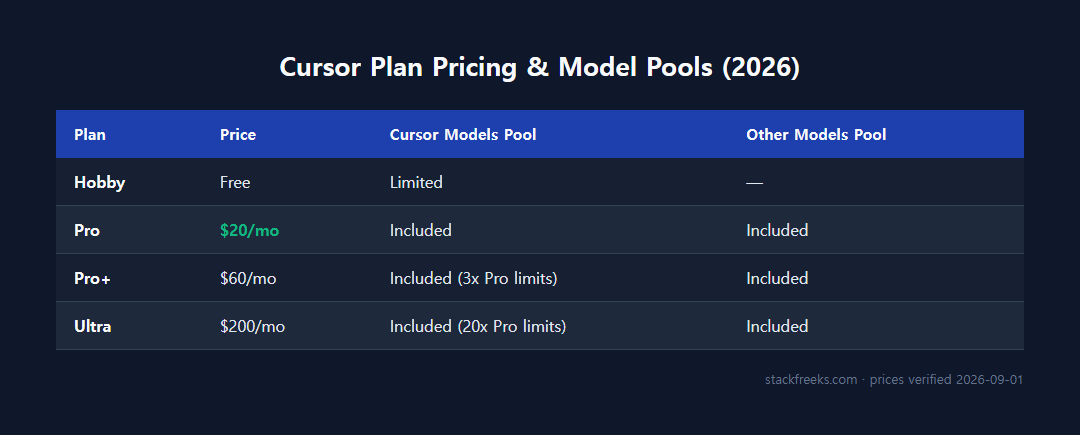
Current Cursor Plan Prices (2026)
| Plan | Price | Cursor Models Pool | Other Models Pool |
|---|---|---|---|
| Hobby | Free | Limited | — |
| Pro | $20/mo | Included | Included |
| Pro+ | $60/mo | Included (3x Pro Agent limits) | Included |
| Ultra | $200/mo | Included (20x Pro Agent limits) | Included |
| Start (India-only) | ₹649/mo | Included | Not included |
| Teams – Standard | $40/user/mo | Included (Composer/Auto pool) | Separate Third-Party API pool |
| Teams – Premium | ~$120/user/mo effective (5x Standard) | Included | Included |
| Enterprise | Custom | Pooled/invoice billing | Pooled/invoice billing |
Prices last checked: 2026-09-01
Teams pricing was restructured in June 2026 to split usage into these two pools — new customers got the change immediately, renewing customers from July 1, 2026.
Auto Mode vs. Manually Picking a Model: The Real Numbers
When you hand-pick a model, you pay that model’s list-price rate against your credit pool for every token. For context, per-million-token rates cited by pricing analysts in 2026 include GPT-5 Mini at $0.25 input / $2.00 output, Claude 4.5 Haiku at $1.00 input / $5.00 output, and Claude 4.6 Opus (Fast) at $30.00 input / $150.00 output — a roughly 120x spread between the cheapest and most expensive input rate alone. That spread is the entire reason routing can save money: send routine work to the cheap end, reserve the expensive end for problems that actually need it.
Cursor’s own Router launch post backs this up with first-party numbers: online A/B tests showed roughly 60% savings using Router versus routing everything to a frontier model, and early enterprise adopters reported 30–50% lower cost compared to sending every request to Opus 4.8. Cursor’s cited cost-per-commit figures are $6.76 (Intelligence mode) and $4.63 (Balance mode), against $12.69 for a comparison model and $7.34 for routing everything to Opus 4.8.
Worth flagging directly: those are Cursor’s own benchmark numbers from a company launch blog post, not figures independently reproduced by a third party. Treat the 60% and 30–50% claims as vendor-reported until someone outside Cursor runs the same comparison.
The closest thing to an independent check comes from a DEV Community writeup that ran five tasks of increasing complexity — a simple UI change through architecture design and test debugging — twice each, once on Auto and once on manually selected Claude Sonnet 4.5, with model choice as the only variable. Auto matched or beat Sonnet’s speed on every task (17 seconds faster on the architecture task, 3 seconds faster on a React debugging task), and the tester found no obvious quality gap: on the debugging task, Auto fixed the issue with a beforeEach setup while Sonnet used .clear() — different approaches, both valid. The writer’s conclusion was that “the ‘Auto is cheating you’ concern doesn’t hold up,” at least for that five-task sample. One real limitation: the piece couldn’t confirm which specific models Auto actually selected behind the scenes, which caps how much it proves about routing quality specifically.
Is Auto Mode’s Quality Actually Reliable?
Here’s where the picture gets genuinely split, and the split is time-dated enough to matter.
Cursor’s own community forum has an active thread, dated around March 11, 2026, where multiple users reported a sudden, sharp quality drop in Auto mode. One user (douglasg14b) called it “abysmally bad” and “effectively useless” within days, describing it as “reminiscent of GPT-3.5, janky” — failing to retain context from recent prompts, refusing direct instructions, and undoing its own prior work. Other users (TLU, sravasti) reported similar degradation after a recent update, describing it as happening “almost overnight.” One user spotted evidence Auto had routed to what they identified as “gpt 5.4 nano” — a much weaker model than expected — and the thread speculated, without confirmation from Cursor, that this was a deliberate downgrade to nudge users toward premium tiers. Some frustrated users mentioned evaluating Windsurf as an alternative; our Windsurf vs. Cursor comparison covers how that pricing and quality tradeoff actually shakes out.
Set against that, the DEV Community five-task test described above found no quality gap between Auto and manually selected Sonnet 4.5. Cursor’s own Router announcement frames the tradeoff as achieving “frontier-quality performance at 60% savings” — implying that, when routing works as designed, users shouldn’t notice a drop at all.
The honest read: the research doesn’t confirm whether the DEV Community test ran before or after the July 2026 Router launch, so these two data points can’t be definitively reconciled into “Auto got fixed” or “Auto is still unreliable.” The most plausible explanation is that the March complaints reflect the pre-Router black-box system and the later test reflects a genuinely different routing engine — but that’s a reasonable inference, not a confirmed fact. If you’re evaluating Auto mode today, weigh both reports and watch your own output quality for the first week rather than assuming either verdict applies to your account.
Separately, broader Cursor complaints not specific to Auto mode are worth knowing about for context: users on Trustpilot and elsewhere report UI lag on files over 500 lines, increased crashes under heavy AI usage, occasional hallucinated functions needing manual verification, and allegations that advertised “unlimited” usage hides strict token limits. These are general platform-trust complaints attributed to user reports, not confirmed facts about Auto specifically.
Cursor vs. Claude Code vs. GitHub Copilot: Cost Predictability
Auto mode’s savings only matter if you can also predict your total bill, and Cursor is consistently rated the least predictable of the three mainstream options — because manual and third-party model usage draws from an uncapped, pay-as-you-go pool once your included credits run out.
Claude Code uses rolling 5-hour usage windows with flat $100–$200/month Max-tier pricing, which gives users a clear spending ceiling instead of Cursor’s overage-based billing. Both tools start at $20/month for entry tiers as of mid-2026, but the spend shape diverges fast — comparison-site estimates put daily agent users on Cursor in the $60–$100/month range once third-party model usage is factored in. One independent benchmark cited by Composio found Claude Code uses 5.5x fewer tokens than Cursor for identical tasks, though the same source notes Cursor comes out cheaper for small, surgical edits, while Claude Code’s higher token burn pays off on large-repo reads and long autonomous runs. If rate limits on Claude Code have bitten you before, our guide to why Claude Code hits rate limits explains the usage-window mechanics behind that.
GitHub Copilot overhauled its billing on June 1, 2026, replacing Premium Request Units with GitHub AI Credits (1 credit = $0.01) and moving to clearer plan tiers: Pro at $10/month (includes $15 in credits, no Opus-class models), Pro+ at $39/month (includes $70 in credits, keeps Opus-class access), and Max at $100/month (includes $200 in credits). Default token pricing is $2.00/M input and $10.00/M output, with some models offered at a temporary 50%-off promotional rate through September 3, 2026. Copilot lands in the middle: clearer plan caps than Cursor’s uncapped overage model, but still usage-sensitive within a given tier. For a closer side-by-side, our Cursor vs. GitHub Copilot comparison for Python developers walks through both tools on identical tasks.
Per independent comparison sources, the predictability ranking looks like: Claude Code (flat capped tiers) ahead of GitHub Copilot (credit-bundle plans with clearer caps) ahead of Cursor (uncapped per-token overage, split across two pools that are easy to lose track of).
Who Auto Mode Is Actually Worth It For
Auto mode makes the most sense if you’re doing high-volume, mixed-complexity work — a lot of small edits, some UI tweaks, occasional harder problems — and you’d rather not manually swap models for every request. The routing logic is specifically designed to route cheap requests to cheap models, so if most of your day is routine changes, Auto should, in theory, burn through your credit pool slower than defaulting to a mid-tier model for everything.
Auto is a worse fit if you need predictable spending above all else. Because Auto now draws from the same credit pools as manual selection and overage billing is uncapped, a week of unusually complex requests can push your bill higher without much warning — the opposite of Claude Code’s fixed-window ceiling. It’s also a weaker choice right now if you were burned by the March 2026 quality complaints and haven’t verified for yourself that routing quality has stabilized; there’s no independent, dated confirmation that the issue is fully resolved, only Cursor’s own claims and one favorable independent test of uncertain timing.
If cost predictability matters more to you than potential savings, Claude Code’s flat Max tiers are the safer bet. If you want Cursor’s editor experience but more control over spend, manually selecting cheaper models (GPT-5 Mini, Claude Haiku) for routine tasks and reserving Auto or a frontier model for genuinely hard problems gives you more predictability than leaving Auto on Intelligence mode by default.
FAQ
Does Cursor Auto mode still save money in 2026?
It can, but not the way it used to. Since the July 22, 2026 Router update, Auto bills at the routed model’s list price and draws from your regular credit pools — it no longer bypasses them. Savings now come from Auto routing more requests to cheaper models than a human typically would, not from Auto being unmetered.
Is Cursor Auto mode the same as before the Router update?
No. Before July 22, 2026, Auto usage was billed at flat token rates and didn’t touch your paid-plan credit pool at all. After the update, Auto draws from either the Cursor Models pool or the Other Models pool depending on what it routes to, and overage billing applies once a pool is exhausted.
Why did people say Cursor Auto mode got worse in March 2026?
Users on Cursor’s community forum reported a sudden quality drop around March 11, 2026, including suspicion that Auto was silently routing to a much weaker model. Cursor never confirmed the cause. It’s not established whether this reflects the current post-Router system or the earlier, more opaque routing logic.
Should I use Auto mode or manually pick a model in Cursor?
If you want simplicity and do a lot of routine, low-complexity work, Auto is reasonable — Cursor’s own data claims meaningful savings versus defaulting everything to a frontier model. If predictable spending matters more than convenience, manually picking cheaper models for routine tasks (and saving frontier models for hard problems) gives you tighter control over your bill.
How does Cursor Auto mode compare to Claude Code or GitHub Copilot on cost?
Claude Code’s flat $100–$200/month Max tiers with rolling 5-hour windows are rated the most predictable of the three. GitHub Copilot’s credit-bundle plans ($10/$39/$100) are a middle ground. Cursor, including Auto mode, is rated least predictable because of its uncapped per-token overage billing once included pools run out.
Final Verdict: Is Cursor Auto Mode Worth It in 2026?
Cursor Auto mode worth it in 2026 comes down to what you’re optimizing for. If you want less manual model-switching and you do mostly routine coding work, Auto is a defensible default — Cursor’s own benchmarks claim roughly 60% savings against always using a frontier model, and the one independent test available found no quality gap against manually selected Claude Sonnet 4.5. Just don’t mistake it for the “free unlimited” version of Auto that circulated through most of 2026 — that billing model ended on July 22, 2026, and Auto now spends from the same credit pools manual selection does.
If unpredictable spend is a dealbreaker, or you were burned by the March 2026 quality complaints and haven’t re-tested it yourself, don’t take Auto on faith. Check your own usage dashboard after a week, compare it against what manual model selection would have cost for the same work, and decide from your own numbers rather than either the vendor’s benchmark or a single forum thread.