This post contains affiliate links. If you purchase through our links, we may earn a commission at no extra cost to you.
If your Copilot bill suddenly looks different this summer, you’re not imagining it. On June 1, 2026, GitHub quietly replaced the old premium-request system with GitHub AI Credits — a token-metered model where cost tracks exactly how much you use, not how many messages you send. The sticker prices on Pro and Pro+ didn’t change. What buying those dollars gets you did, and for anyone leaning on frontier models in Agent Mode, it changed a lot.
What Actually Changed: Premium Requests to GitHub Copilot AI Credits
Before June 2026, Copilot billed on premium requests. Every chat message, agent turn, CLI call, or code review counted as one “request,” and each model carried a multiplier — a request answered by a 50x-multiplier model like GPT-4.5 cost the same as 50 standard requests, regardless of how long or short the exchange actually was. Plans included a flat monthly quota (Pro: 300 requests, Pro+: 1,500), and going over cost a flat $0.04 per request.
That flat-count model is gone. Under GitHub AI Credits, cost is calculated from actual input, output, and cached tokens consumed, priced at each model’s published API rate, and denominated in credits where 1 credit = $0.01. A short chat question and a long, context-heavy agent task on the exact same model can now cost wildly different amounts — something the old per-request system never captured. GitHub’s own transition announcement is blunt about the other half of the change: “fallback experiences will no longer be available.” Previously, running out of premium requests meant Copilot quietly downgraded you to a cheaper model. Now, once your credit balance is gone, you’re either paying overage at metered rates or you’re stopped.
One thing didn’t change: code completions and Next Edit Suggestions stay unlimited and free on every plan, under both the old and new systems. The credit meter only applies to Chat, Agent Mode, code review, the CLI, and Copilot Spaces.
GitHub Copilot Pricing and Credit Allotments in 2026
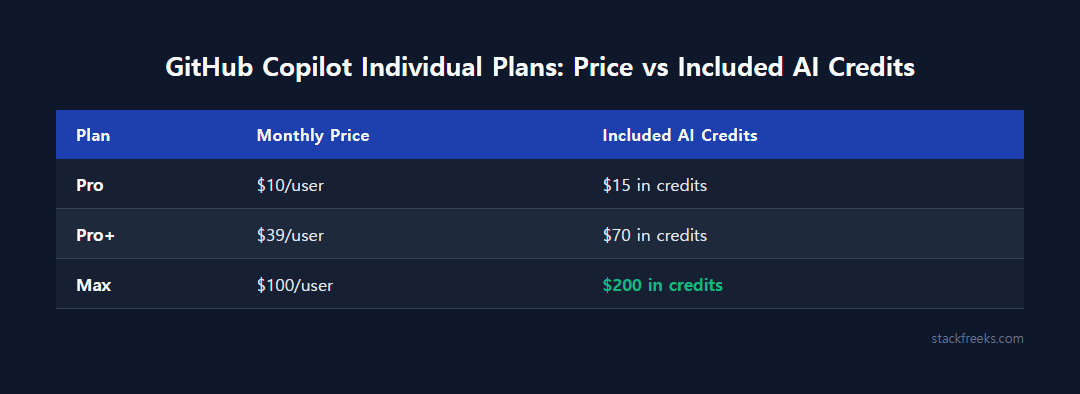
| Plan | Monthly Price | Included AI Credits | Notes |
|---|---|---|---|
| Free | $0 | 2,000 code completions/month + limited chat | No paid credit allotment |
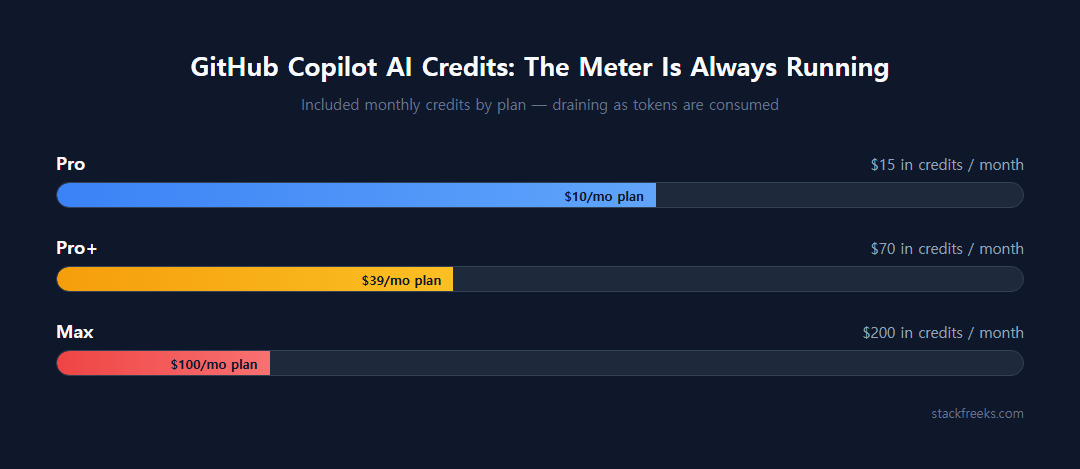
| Pro | $10/user | $15 in monthly credits | Widely-cited figure; unclear if permanent (see caveat below) |
| Pro+ | $39/user | $70 in monthly credits | Intended for heavier individual agent use |
| Max | $100/user | $200 in monthly credits | New top individual tier, priority access to new models |
| Business | $19/user | Promotional $30/user (June–Aug 2026), reverts to standard allotment after | Centralized policy control, broad model catalog |
| Enterprise | $39/user | Promotional $70/user (June–Aug 2026), reverts to standard allotment after | Adds codebase indexing, priority model access |
Prices last checked: September 2026.
Two things in that table are worth flagging as promotional or unconfirmed rather than standard, permanent numbers:
- The Business and Enterprise “promotional” allotments are explicitly transition-window bumps that GitHub itself frames as temporary, reverting to a lower plan-standard amount after August 2026.
- The Pro/Pro+/Max figures ($15/$70/$200) are the numbers most consistently cited across coverage, but it isn’t clear from available sources whether those are locked-in steady-state allotments or could shrink post-transition the way the Business/Enterprise numbers explicitly will. One aggregator source frames Pro’s $15 credit allotment as exceeding the $10 sticker price; GitHub’s own transition messaging leans toward the allotment matching the price point more closely once promotions end. Treat the individual-tier numbers as currently accurate, not guaranteed.
How Credits Actually Get Burned Per Model and Task
The old multiplier system was crude but predictable: a 50x model cost 50x, every time, no matter what you asked it. The new system scales continuously with tokens, so the same question can cost very different amounts depending on how much context gets sent and how long the response runs.
Third-party aggregator analysis (UsageBox) reports that expensive frontier models — GPT-5.5, Claude Opus 4.7 — burn credits roughly 5–10x faster than budget models like Gemini Flash or GPT-4o-mini, and that a single complex agent task on a frontier model can run $0.50–$2.00 in credits. One documented case had a Pro+ subscriber burning 1,180 credits — about 16% of their entire monthly Pro+ allowance — on one agent coding task that produced mediocre results. One caveat matters here: GitHub has not published an official per-model, per-token rate card. The exact multiplier figures come from third-party estimates, not GitHub’s own documentation, so treat them as directionally accurate rather than confirmed rates.
Real-World Solo Dev Cost Scenarios
A representative mixed-workflow day for a Pro+ subscriber ($39/month, $70 in credits), compiled from aggregator analysis, looks like this:
| Activity | Estimated Cost |
|---|---|
| 200 tab/code completions | Free (unmetered) |
| 15 chat messages on a budget model | ~$0.30 |
| 5 Agent Mode tasks on a Claude Opus-tier model (~30K tokens each) | ~$5–8 |
| 2 large multi-file refactors on a frontier model (e.g., GPT-5.5) across 5 files | ~$4–6 |
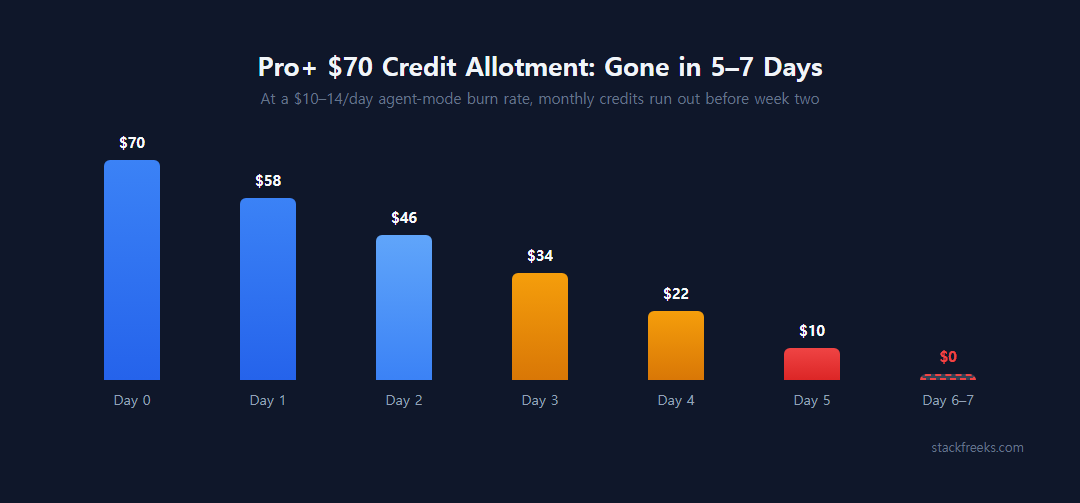
| Estimated daily burn | $10–14/day |
At that pace, a full $70 monthly Pro+ allotment is gone in roughly 5–7 days if the pattern repeats daily — meaning a solo dev who codes every day and leans on agent mode with frontier models could exhaust a month’s credits before the second week starts, then face either overage billing at the same metered rate or a hard stop, since the old fallback-to-cheaper-model behavior no longer exists.
The self-reported numbers circulating since launch are more dramatic, and worth stating carefully as anecdotes rather than universal outcomes:
- One developer reported a jump from roughly $29/month to a projected ~$750/month.
- Another reported roughly $50/month jumping to a projected ~$3,000/month.
- A Pro+ user reported burning about 8% of their monthly allotment within two hours of normal work.
- Another reported a single feature request costing over $6.
These figures come from social-media and forum posts surfaced by TechCrunch and The Register — not audited billing statements. Some commenters in the same threads pushed back, attributing the worst bills to inefficient “vibe coding” prompting habits rather than the pricing model itself, and noting that Microsoft’s old flat-rate system had actively encouraged the kind of unrestrained agent usage that now produces sticker shock. That’s a real counterpoint worth holding alongside the anecdotes — but it doesn’t change the fact that the same workflow that cost a flat $10 or $39 in May now has no ceiling beyond your card limit.
Overage: What Happens When You Run Out
Under the old system, going over your premium-request quota cost a flat $0.04 per request, scaled by whatever multiplier the model carried. Under GitHub AI Credits, there’s no separate flat overage fee — once your included allotment is gone, paid plans (Pro, Pro+, Max, Business, Enterprise) can keep going, billed at the exact same per-token API rate used to meter the included credits. It’s continuous metering, not a penalty tier. The Free plan has no overage option at all; usage simply stops at the included allotment.
What Developers Are Actually Saying
Coverage of this change has been overwhelmingly negative, and no offsetting positive developer testimonials turned up in the reporting reviewed for this piece — so this section reflects that skew honestly rather than manufacturing a balanced-sounding quote that doesn’t exist in the source material. Visual Studio Magazine’s April 2026 pre-launch coverage summed up the sentiment before the change even shipped: “you will get less, but pay the same price.”
Once the change went live, TechCrunch (Lucas Ropek, May 30, 2026) quoted a developer calling the new system “just stupidly expensive” and reported the self-described cost jumps mentioned above. The Register (O’Ryan Johnson, June 2, 2026) reported a developer describing the shift as going from “a predictable subscription” to “a stressful meter-based” service, and noted some developers stating intentions to migrate workloads to Anthropic’s or OpenAI’s direct APIs, or to routing layers like OpenRouter, RooCode, or LM Studio. gHacks Tech News corroborated “rapid credit depletion” as the dominant launch-week complaint. Microsoft did not respond to TechCrunch’s request for comment as of that article’s publication.
The one meaningful counterpoint in the same coverage: some commenters argue the backlash conflates two separate things — a genuinely fairer, more granular cost allocation for light users, and a jarring transition for heavy agent users who built workflows around a flat-rate system Microsoft itself had encouraged. Both things can be true. Neither changes what a heavy Agent Mode user should expect their bill to look like starting this summer.
GitHub Copilot AI Credits vs Cursor vs Claude Code: Pricing Predictability Compared
Copilot isn’t alone in moving this direction — it’s arguably catching up to where Cursor and Claude Code already were.
Cursor (2026 pricing): Hobby (free), Pro ($20/month, $20 of included model usage), Pro+ ($60/month, $70 included), Ultra ($200/month, $400 included), plus Teams and Enterprise tiers. Each paid plan buys a fixed dollar pool of third-party model usage billed at API rates; once it’s gone, Cursor bills overage in arrears at the model’s actual rate. Structurally, that’s close to what Copilot just adopted. our Cursor vs Copilot comparison covers the feature-level differences if pricing structure isn’t the only factor you’re weighing. Cursor’s own plan structure has shifted multiple times in 2026 already — we’ve covered why Cursor bills spike for developers who hit the same kind of shock Copilot users are experiencing now.
Claude Code (Anthropic): Access splits between subscription plans — Pro ($20/month with usage caps), Max ($100 or $200/month for 5x or 20x higher limits), Team/Enterprise seats — which meter usage against rate-limited windows rather than charging per token directly, or pure pay-per-token API access (Claude Sonnet 5 at $2/$10 per million input/output tokens, Claude Opus 5 at $5/$25 per million, Claude Haiku 4.5 at $1/$5 per million). Prompt caching cuts effective input cost by roughly 90% on repeated context, which matters a lot for Claude Code’s typical pattern of re-sending a large, stable codebase context every turn. If you’ve run into throttling on a Claude subscription tier, our breakdown of Claude Code rate limits explains how those windows work differently from Copilot’s credit-balance model.
The practical takeaway for a solo developer isn’t “flat-rate vs. metered” anymore — that era is basically over across the category. What actually differs between these three tools now is (1) how large the included allotment is relative to your real usage pattern, (2) whether the tool still degrades gracefully to a cheaper model when you’re running low — Copilot just removed this, which is the single most-cited cause of the price-shock complaints — and (3) whether the vendor prices its subscription as a markup over its own API rates or passes usage through closer to cost. If you’re trying to model your own burn rate before committing to a tier, our Cursor Auto Mode cost breakdown walks through a similar per-task cost exercise that applies just as well to Copilot’s Agent Mode.
Frequently Asked Questions
Did GitHub Copilot’s subscription prices go up in June 2026?
No. Pro ($10), Pro+ ($39), Business ($19/user), and Enterprise ($39/user) sticker prices stayed the same. What changed is how much usage those prices buy — heavy Agent Mode users on frontier models get less effective usage per dollar than they did under the old flat premium-request system.
Are code completions still free under GitHub AI Credits?
Yes. Code completions and Next Edit Suggestions remain unlimited and unmetered on every plan, both before and after the June 2026 change. The credit meter only applies to Chat, Agent Mode, code review, the CLI, and Copilot Spaces.
What happens if I run out of AI Credits mid-month?
Paid plans can continue past their included allotment, billed at the same per-token API rate used to meter the included credits — there’s no flat overage fee like the old $0.04/request system. GitHub has removed the previous fallback behavior of quietly downgrading you to a cheaper model when you’re out of quota, so running out now means either paying metered overage or being stopped, depending on your plan’s settings.
Is GitHub Copilot’s new pricing worse than Cursor or Claude Code?
Not inherently — all three have moved toward metering actual token usage rather than a flat subscription. The real difference is predictability: Cursor and Claude Code’s subscription pools are generally described as priced close to their underlying API cost, and Copilot’s included credits are now being framed the same way. Which one is cheaper for you depends entirely on how heavily you use frontier models in agent workflows, not on which company’s marketing sounds friendlier.
Final Verdict: Should You Keep Paying for GitHub Copilot in 2026?
If your workflow is mostly code completions with the occasional chat question, GitHub Copilot’s AI Credits billing barely touches you — that usage stays free or nearly free, and Pro at $10/month still looks like a reasonable deal. The math only turns ugly if you’re running Agent Mode tasks against frontier models like GPT-5.5 or Claude Opus 4.7 multiple times a day; that’s the exact usage pattern behind the $29-to-$750 and $50-to-$3,000 anecdotes making the rounds.
For that heavier group, the fix isn’t necessarily switching tools — Cursor and Claude Code have the same fundamental economics now — it’s tracking your actual burn rate before you’re surprised by it. Watch which model each task defaults to, push routine work toward budget models, and reserve frontier models for the tasks that actually need them. If you’re already comparing alternatives on cost grounds rather than features, our AI coding assistant comparison is the better starting point than any single vendor’s pricing page — because right now, every vendor’s pricing page is telling a more optimistic story than its own users are.